Understanding the Frequency Output
A Gaussian Frequency calculation produces a large amount of information. Most of this output is intended for internal numerical procedures and can safely be ignored by most users.
The sections discussed below are the most important when interpreting a vibrational frequency calculation.
1. SCF Energy
Before the vibrational analysis begins, Gaussian performs a final electronic structure calculation.
Typical output

What does this mean?
This is the electronic energy of the molecular geometry used for the frequency calculation.
Notice that this value is identical (or nearly identical) to the final energy obtained from the geometry optimization.
The frequency calculation does not optimize the geometry. Instead, it analyzes the optimized structure by calculating the second derivatives of the energy.
2. Low Frequencies
Soon after the SCF calculation, Gaussian prints

What are Low Frequencies?
These correspond to
- molecular translations,
- molecular rotations,
- very soft vibrational motions.
For an ideal optimized nonlinear molecule,
the first six modes correspond to
- three translations,
- three rotations,
and should have frequencies close to 0 cm⁻¹.
Because of numerical approximations,
very small positive or negative values may appear.
Examples
These are generally not considered true imaginary vibrational frequencies.
3. Harmonic Frequencies
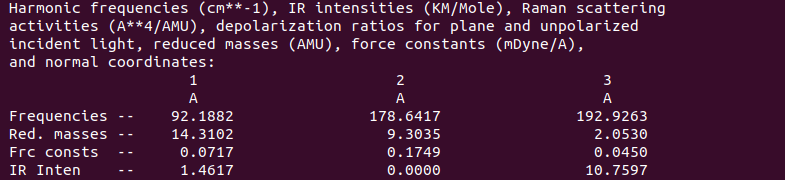
The most important section of the output begins with
followed by blocks such as
Vibrational Frequencies
This line lists the vibrational frequencies in cm⁻¹.
Each value corresponds to one normal mode of vibration.
Examples include
- bond stretching,
- bond bending,
- torsional motion,
- wagging,
- rocking.
For the formic acid dimer, all reported vibrational frequencies are positive, indicating that the structure corresponds to a stable stationary point. :contentReference[oaicite:0]{index=0}
Reduced Mass
The reduced mass represents the effective mass associated with each vibrational mode.
Heavy-atom vibrations generally have larger reduced masses than vibrations dominated by hydrogen atoms.
The reduced mass influences both the vibrational frequency and the infrared intensity.
Force Constant
The force constant measures the stiffness of the vibrating bond.
Large force constants indicate
- strong bonds,
- higher vibrational frequencies.
Small force constants correspond to softer vibrational motions.
IR Intensity
This quantity determines how strongly each vibrational mode absorbs infrared radiation.
Large values correspond to
- strong IR absorption peaks,
whereas
indicates an IR-inactive vibrational mode.
4. Normal Coordinates
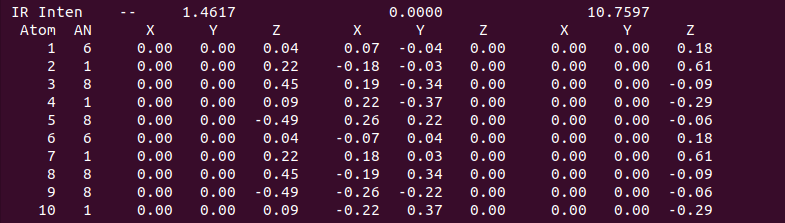
Immediately below each frequency block,
Gaussian prints a table containing atomic displacements.
What are Normal Coordinates?
Each column represents one vibrational mode.
Each row describes how one atom moves during that vibration.
The values correspond to relative atomic displacements,
not absolute distances.
These coordinates are used by visualization programs such as
- GaussView,
- Avogadro,
to animate molecular vibrations.
5. Thermochemistry
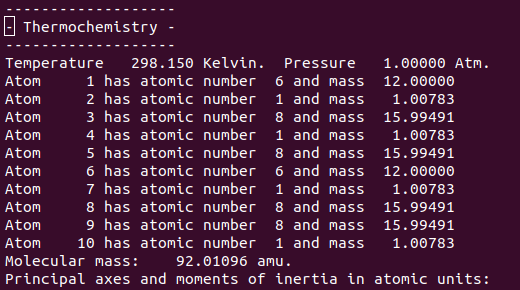
Near the end of the output,
Gaussian prints
Purpose
This section contains the thermodynamic properties calculated from the vibrational frequencies.
Typical quantities include
- Zero-Point Energy (ZPE),
- Thermal Correction to Energy,
- Thermal Correction to Enthalpy,
- Thermal Correction to Gibbs Free Energy,
- Entropy,
- Heat Capacity.
These values are widely used in
- reaction energy calculations,
- thermodynamic studies,
- computational kinetics.
The calculations are performed at the specified temperature (298.15 K) and pressure (1 atm) by default. :contentReference[oaicite:1]{index=1}
6. Zero-Point Energy (ZPE)
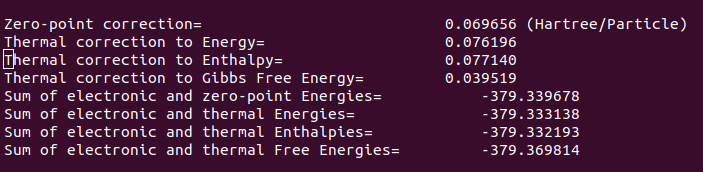
Within the thermochemistry section,
Gaussian reports
What is Zero-Point Energy?
Even at absolute zero,
atoms continue to vibrate due to quantum mechanical effects.
The corresponding vibrational energy is called the Zero-Point Energy (ZPE).
It is frequently added to the electronic energy when comparing molecular stabilities or reaction energies.
7. Thermal Corrections
The thermochemistry section also contains
Purpose
These corrections account for
- vibrational motion,
- rotational motion,
- translational motion,
- thermal population of energy levels.
They are essential for computing thermodynamic quantities under experimental conditions.
8. Sum of Electronic and Thermal Energies
Near the end of the thermochemistry section,
Gaussian reports values such as
Sum of electronic and zero-point Energies

Sum of electronic and thermal Energies

Sum of electronic and thermal Enthalpies

Sum of electronic and thermal Free Energies
Importance
These corrected energies are generally used instead of the raw SCF energy when comparing
- reaction energies,
- relative molecular stabilities,
- activation barriers,
- Gibbs free energies.
9. Normal Termination
Finally,
Gaussian prints

Interpretation
This confirms that
- the SCF calculation converged,
- the Hessian matrix was successfully computed,
- the vibrational analysis completed without errors.
A successful frequency calculation should always end with
Your calculation completed successfully. :contentReference[oaicite:2]{index=2}
Summary
The most important parts of a Gaussian Frequency output are the final SCF energy, the harmonic vibrational frequencies, reduced masses, force constants, infrared intensities, normal coordinates, thermochemistry section, Zero-Point Energy, thermal corrections, and the final corrected energies. Together, these quantities allow the user to verify the nature of the stationary point, predict infrared spectra, and compute thermodynamic properties required for chemical and spectroscopic studies.