Quantum Pilot
Three local, open source tools that automate real Gaussian, GAMESS, and MCTDH workflows end to end from a SMILES string to a verified reaction barrier, a fully characterized excited state, or a vibronic-coupling model ready for quantum dynamics.
Install Locally View Source on GitHub
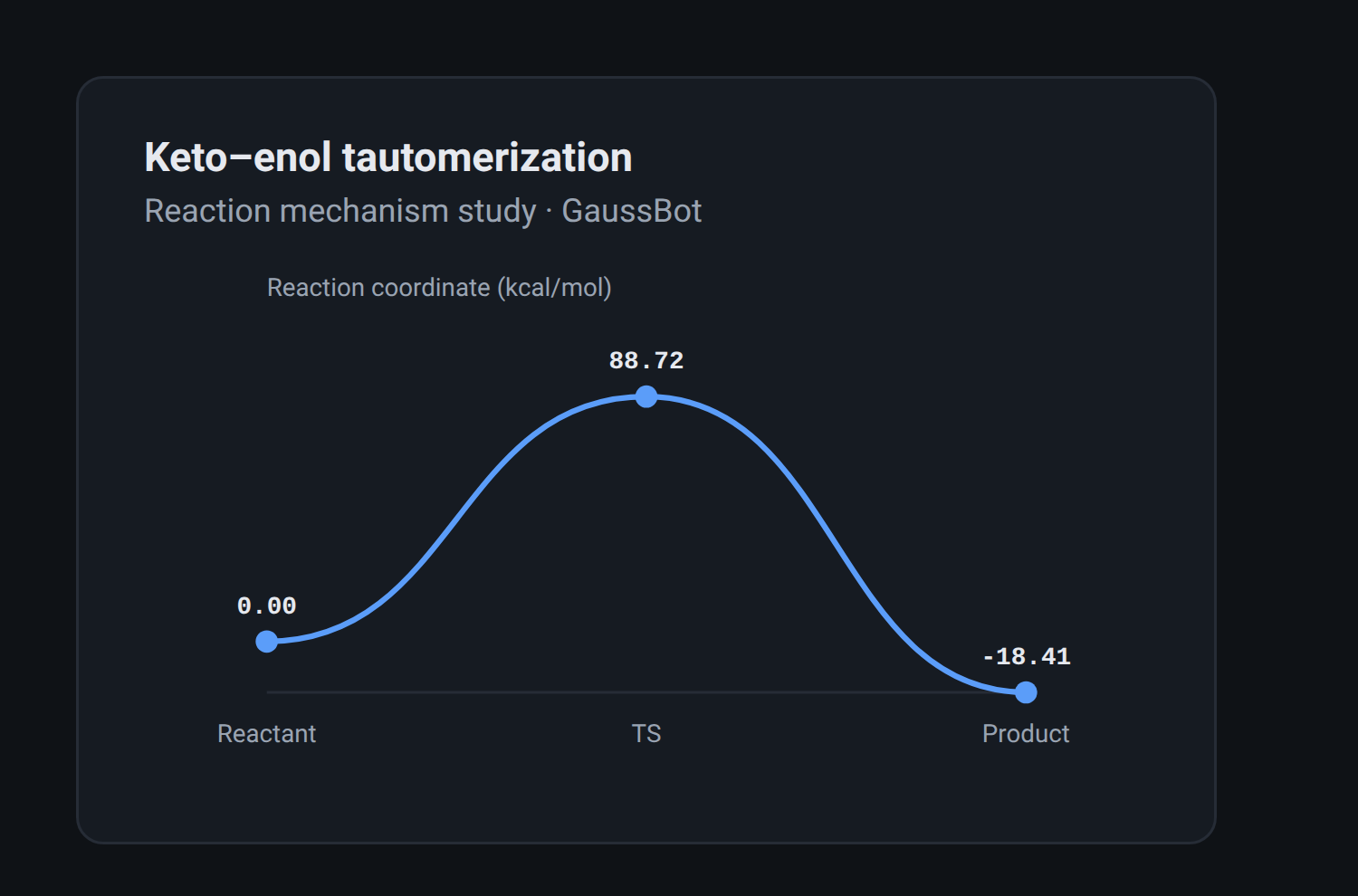
GaussBot, real reaction-coordinate diagram from a completed mechanism study
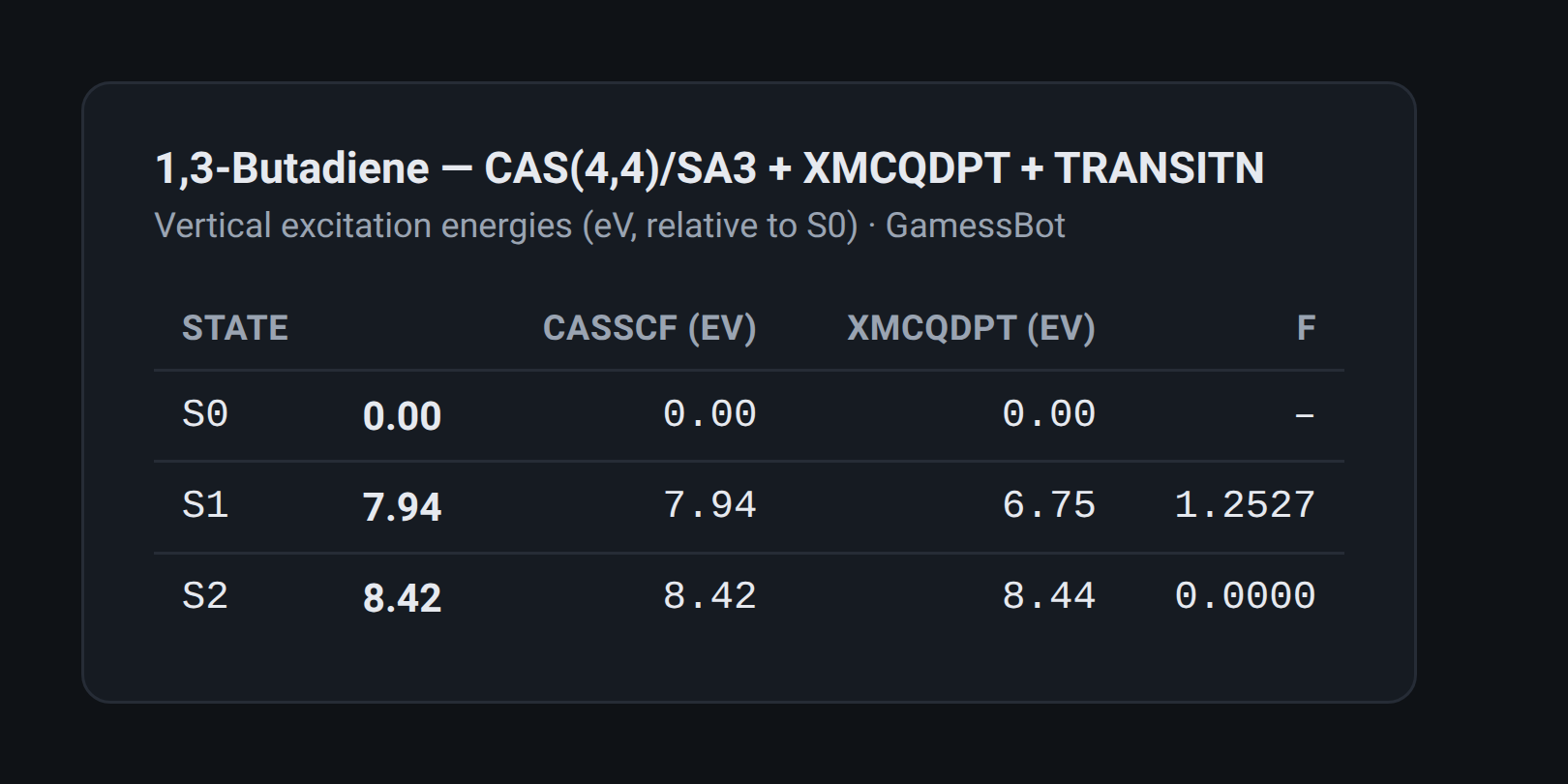
GamessBot, real CASSCF/XMCQDPT excitation-energy table, straight from a completed run
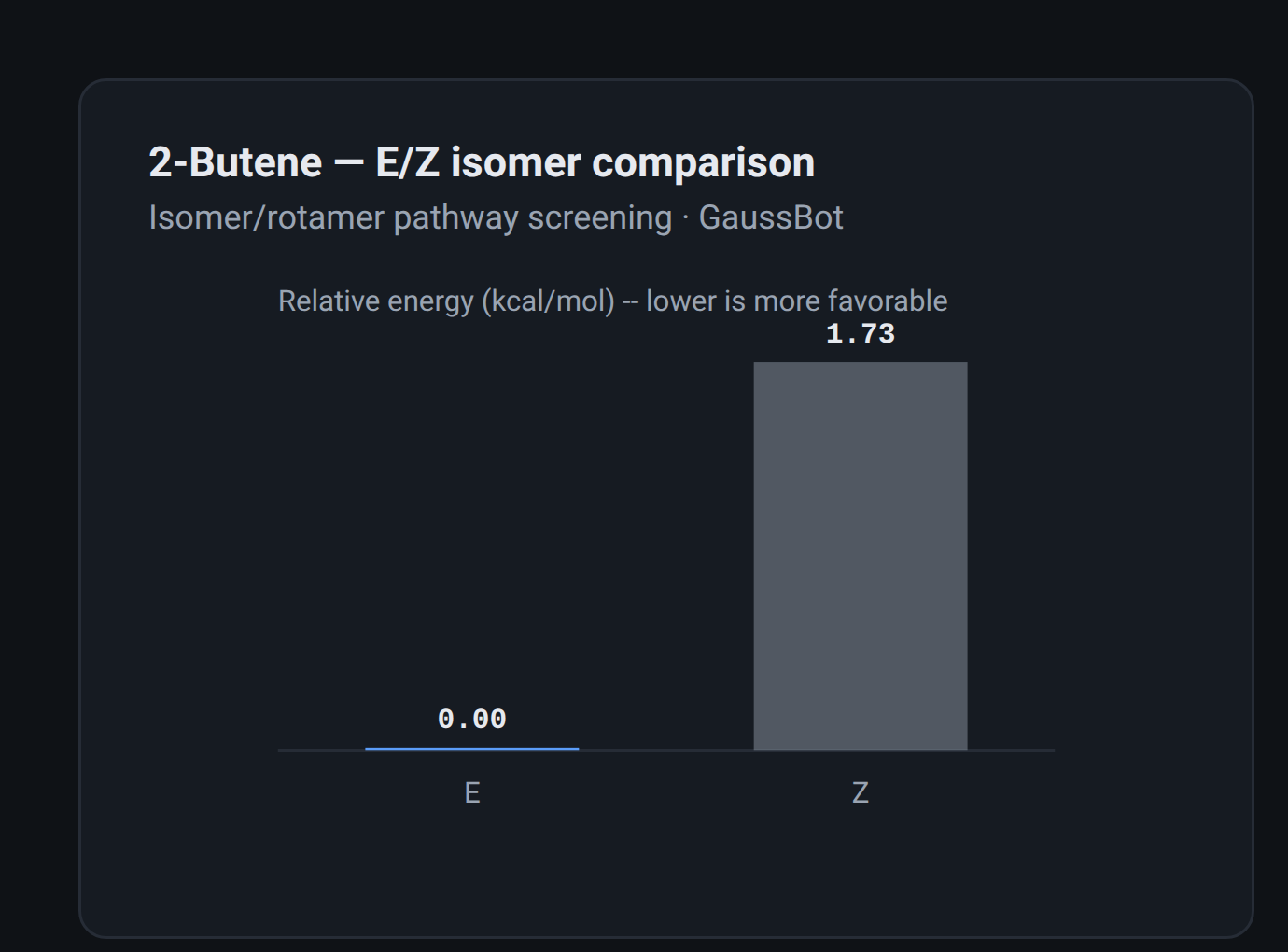
GaussBot, real E/Z isomer energy comparison from an isomer/rotamer pathway screen
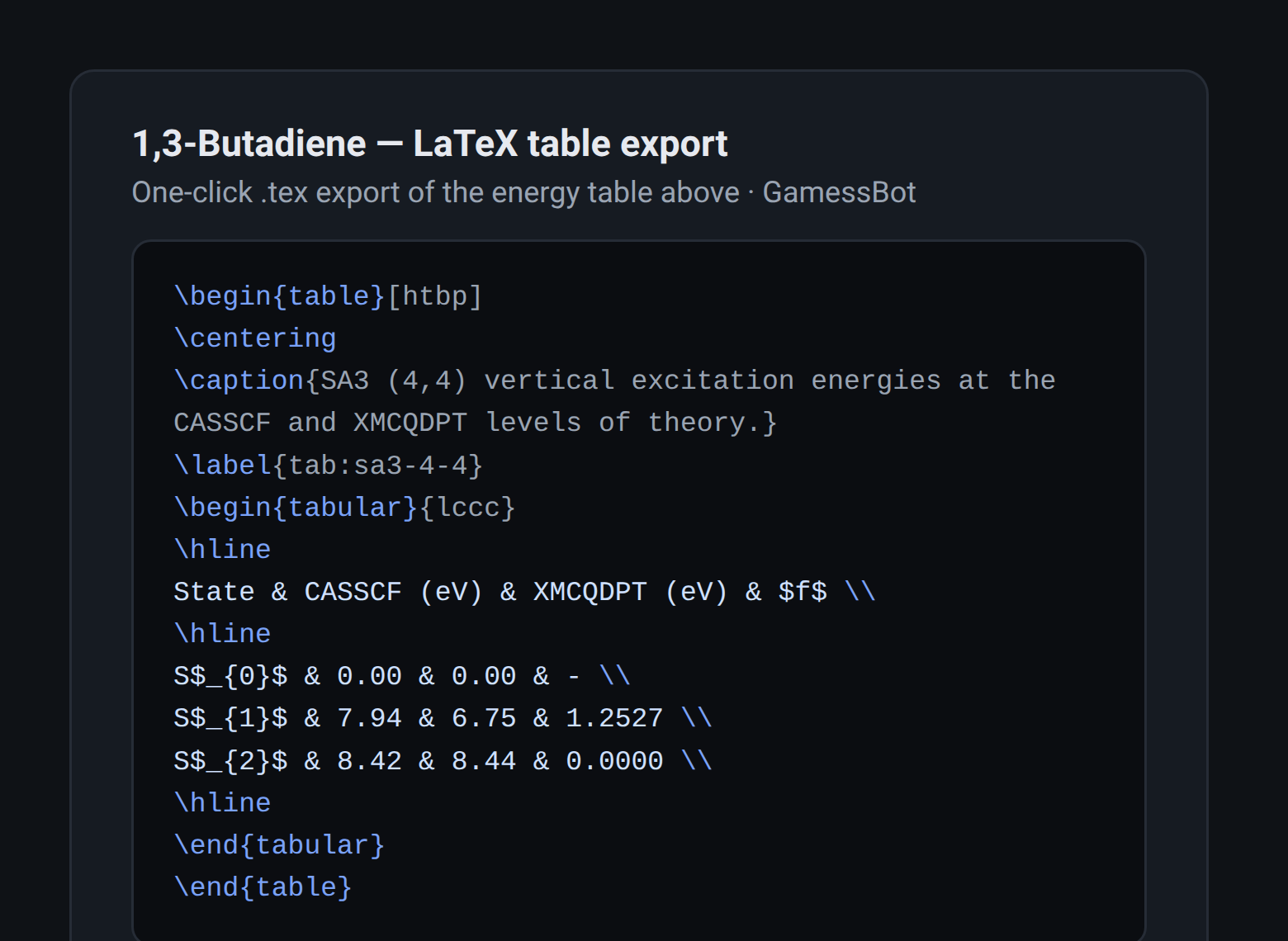
GamessBot, the same result, one click away from a real LaTeX table for your paper
Why this exists
Setting up a real computational study by hand is mostly bookkeeping, not chemistry: build a reactant, build a product, pre optimize, reoptimize at the final level, guess a transition state, verify it with IRC, go back and fix whatever didn't converge. For a multireference study it's worse, pick an active space by staring at CIS output, hope you didn't miss an important orbital, wait for CASSCF to either converge or not, then decide what to try next.
Quantum Pilot is a set of sibling tools that automate that bookkeeping, each wrapped in both a local web GUI and a command line interface, so the actual chemistry, the level of theory, the active space, the interpretation of the result, stays entirely in your hands. Building a vibronic-coupling model for quantum dynamics is worse still, frequency calculation, displace along each normal mode, run a multireference calculation at every displaced point, diabatize, fit, and assemble an MCTDH operator, by hand, one mode at a time. Dynamics automates that chain too.
-
GaussBot
From a guess geometry to a verified reaction barrier, automatically, locally, using Gaussian. Resilient PM6 then HF/DFT optimization, automated TS search with a reaction overlap check, IRC verification, and a full energy report or just a single geometry optimization.
-
GamessBot
RHF → CIS → CASSCF → XMCQDPT & TRANSITN multireference studies with GAMESS, starting from an already optimized geometry including one GaussBot just produced. Suggests a CASSCF active space directly from the CIS excitations, rather than making you guess one by hand.
-
Dynamics
Frequency → normal-mode distortion → per-point CASSCF/XMCQDPT diabatization → coupling fit → MCTDH operator, built from a completed GaussBot/GamessBot job with GAMESS. Stages that need cluster access generate ready-to-submit inputs instead of blocking on them.
None of these tools do the quantum chemistry itself
All three are orchestration layers around your own licensed Gaussian, GAMESS, and/or MCTDH install. They build input files, run the actual calculations locally on your machine, and parse the logs that come back. Gaussian/GAMESS/MCTDH do the real work; Quantum Pilot removes the manual bookkeeping around them.
All three tools run jobs locally by default, but also support submitting them through a PBS queue for cluster and HPC environments, with an editable job script template so it fits your own queue setup.
GaussBot: reaction mechanism studies
GaussBot runs a complete reaction-mechanism study from nothing but a reactant and product structure, a SMILES string, an uploaded file, or a PubChem lookup.
┌─────────────────┐     ┌────────────────┐
│  Reactant       │     │  Product       │
│  (SMILES/file)  │     │  (SMILES/file) │
└────────┬────────┘     └────────┬───────┘
         ▼                       ▼
┌─────────────────┐     ┌────────────────┐
│ PM6 pre-opt     │     │ PM6 pre-opt    │
│ (resilient,     │     │ (resilient,    │
│  auto-retry)    │     │  auto-retry)   │
└────────┬────────┘     └────────┬───────┘
         ▼                       ▼
┌─────────────────┐     ┌────────────────┐
│ Final-level     │     │ Final-level    │
│ DFT reopt       │     │ DFT reopt      │
└────────┬────────┘     └────────┬───────┘
          \                      /
           \                    /
            ▼                  ▼
        ┌──────────────────────────┐
        │   TS guess + search      │
        │  (checked against the    │
        │   reactant→ product mode │
        └────────────┬─────────────┘
                     ▼
        ┌───────────────────────────┐
        │  IRC verification         │
        │  (confirms the TS         │
        │   actually connects both) │
        └─────────────┬─────────────┘
                      ▼
        ┌────────────────────────────┐
        │  Energy report             │
        │  (barrier, ΔG, G-corr,     │
        │   reaction-coordinate plot)│
        └────────────────────────────┘
Every stage is individually resilient: if a PM6 pre-optimization doesn't converge cleanly, GaussBot retries with automatic fallbacks before ever handing the geometry to the expensive DFT stage. If the IRC doesn't cleanly connect the TS to both endpoints, GaussBot says so plainly rather than pretending it did, and offers two optional recovery strategies (TS-mode distortion, IRC-endpoint reoptimization) for exactly that situation.
GaussBot demo, keto–enol tautomerization
A complete, real, live run example: vinyl alcohol (C=CO) to acetaldehyde (CC=O), the textbook
tautomerization every organic chemist already has intuition for, computed end to end at B3LYP/6-31G(d).
Duration
~7 MinutesVideo Tutorial
Topics Covered
- SMILES / file / PubChem structure intake
- Resilient PM6 then DFT optimization
- Automated TS search with reaction overlap verification
- IRC verification (and what "needs review" means)
- Reading the energy report and reaction coordinate diagram
Related Documentation
GamessBot: multireference studies
GamessBot takes over exactly where a single Slater determinant stops being enough, excited states, near-degenerate orbitals, genuinely multireference character, and automates the RHF → CIS → CASSCF → XMCQDPT & TRANSITN pipeline around GAMESS.
┌──────────────────────┐
│  Optimized geometry  │
│  (Gaussian log,      │
│   GAMESS input, or   │
│  SMILES via Gaussian)│
└──────────┬───────────┘
           ▼
     ┌───────────┐
     │    RHF    │
     └─────┬─────┘
           ▼
     ┌───────────┐
     │    CIS    │  (identifies which orbitals are
     └─────┬─────┘   actually excited-state relevant)
           ▼
┌──────────────────────────┐
│ Suggested CASSCF active  │  (from CIS SAP coefficients,
│ space (user editable)    │   you can always override it)
└─────────────┬────────────┘
              ▼
        ┌───────────┐
        │  CASSCF   │  (state-averaged, with automatic
        └─────┬─────┘   smaller-active-space recovery)
              ▼
   ┌────────────────────────┐
   │ XMCQDPT (dynamic       │
   │ correlation, optional) │
   └───────────┬────────────┘
               ▼
   ┌────────────────────────┐
   │ TRANSITN (oscillator   │
   │ strengths, optional)   │
   └───────────┬────────────┘
               ▼
   ┌────────────────────────┐
   │ Per-combination energy │
   │ table + LaTeX export   │
   └────────────────────────┘
The active space step is the part that normally takes real expertise: staring at CIS output, deciding by hand which orbitals matter. GamessBot automates the first pass, scoring every orbital against the CIS excitations' SAP coefficients, and shows you exactly why each orbital was proposed (its dominant atomic/orbital character) before you ever run anything. You can always edit the proposed MO list directly.
Every active-space/state combination you want to compare is specified upfront, in one form, and then they all run straight through with no further prompts, including an option to continue a later combination from an earlier one's already-converged, possibly reordered orbitals, or start fresh from the closed-shell orbitals, whichever makes sense for that comparison.
GamessBot demo, 1,3-butadiene multireference study
A complete, real, live-run example: 1,3-butadiene (C=CC=C), the textbook conjugated diene, taken
through RHF, CIS, an automatically suggested CAS(4,4) active space, XMCQDPT, and TRANSITN oscillator
strengths.
Duration
~9 MinutesVideo Tutorial
Topics Covered
- Guess geometry intake via GaussBot's own Gaussian pipeline
- RHF and CIS, and reading the dominant transition table
- How the CASSCF active space suggestion works, and the SAP-coefficient threshold
- State averaged CASSCF, and the smaller active space recovery strategy
- XMCQDPT dynamic correlation and TRANSITN oscillator strengths
- Comparing multiple active-space/state combinations in one batch
Related Documentation
Dynamics: vibronic coupling for MCTDH
Dynamics picks up where GamessBot's multireference study ends, and builds a vibronic-coupling model ready to hand to MCTDH: a frequency calculation, a displacement along every normal mode, a multireference calculation at each displaced point, diabatization, a coupling-strength fit, and an assembled MCTDH operator file, orchestrated end to end instead of run one mode at a time by hand.
┌───────────────────────────┐
│  Completed GaussBot job   │
│  (optimized geometry +    │
│   frequency calculation)  │
└─────────────┬─────────────┘
              ▼
   ┌────────────────────────┐
   │ Normal-mode distortion │  (displaced points along
   └────────────┬───────────┘   each vibrational mode)
                ▼
   ┌────────────────────────┐
   │ Per-point CASSCF /     │  (via GamessBot's own
   │ XMCQDPT diabatization  │   RHF -> CIS -> CASSCF chain)
   └────────────┬───────────┘
                ▼
   ┌────────────────────────┐
   │ Diabatic coupling fit  │  (quadratic fit per mode ->
   │ (kappa, gamma)         │   linear/quadratic coupling)
   └────────────┬───────────┘
                ▼
   ┌────────────────────────┐
   │ Mode ranking + QA      │  (fit smoothness, sign-branch
   │                        │   consistency checks)
   └────────────┬───────────┘
                ▼
   ┌────────────────────────┐
   │ MCTDH operator (.op)   │
   │ + PBF/ML-tree input    │
   └────────────────────────┘
Stages confirmed to run reliably on a single local machine (the frequency job, RHF, CASSCF, and the three-fold-way CAS-level bootstrap) run for real by default. Stages that genuinely need cluster-scale GAMESS (the four-fold way used for CAS-level refinement, XMCQDPT-level diabatization, and every distortion point beyond the bootstrap) generate a complete, ready-to-submit GAMESS input instead of blocking on a calculation this machine can't finish, you submit it wherever you have real cluster access, then feed the returned log back in to continue the chain exactly where it left off.
Installing it locally
All three tools, plus a small landing page linking to whichever of them you have running, install from a single script, no account, no cloud service, nothing sent anywhere but your own machine.
-
Install & Download
Full setup instructions: prerequisites, the one-script installer, launching each tool, and the CLI.
-
Installation Walkthrough (Video)
A five-minute recording of the same install, start to finish, on a clean machine.
-
Source Code
MIT-licensed, on GitHub. Read the code, open an issue, or fork it.